

– Advertorial –
Fifteen years after a record cloudburst, Copenhagen has built a model for climate adaptation where the utility and the municipality share the bill and residents help shape the result.
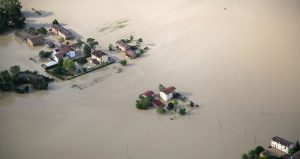
On 2 July 2011, 150 mm of rain fell on Copenhagen in about two hours, the most intense cloudburst ever measured in the city. Basements and streets flooded. Within 30 minutes of the cloudburst, water reached critical infrastructure at the city’s largest hospital and came close to forcing an evacuation. Climate risk assessments had already identified heavy rain as one of the most imminent threats, but nobody expected the city to be tested so soon.
Insurance claims alone exceeded EUR 800 million, and total property damage is estimated at around EUR 1 billion. Fifteen years later, the city’s response is being built street by street.
Listen to the full story of Copenhagen’s cloudburst here.
The calculation that changed Copenhagen’s approach
Until the 2011 cloudburst, the standard Danish response to flooding was bigger sewers. The utility dug, tariff payers paid, and the solution stayed underground. Copenhagen ran the numbers on an alternative.
A sewer-only solution was estimated at around EUR 2.7 billion. A combined approach, expanding the sewers while using parks, squares and streets to hold water on the surface, came to around EUR 1.7 billion. Because surface solutions also create green space and raise the quality of urban life, the assessment found that the combined plan would deliver more value to society than it cost.

The Copenhagen Cloudburst Management Plan followed. The plan combines a larger sewer network below ground with roughly 300 surface projects above it, rolled out over 20 years and prioritised where the risk is highest. The plan was developed jointly by the City of Copenhagen, the utility HOFOR and private engineering consultants. The municipality brought urban planning and public space, the utility brought water management and funding, and the consultants brought hydraulic modelling and design.
The stakeholder methodology developed in that process has since been an inspiration for other large cities, including New York City.
Read the economic assessment behind the plan: Case study, the European Environment Agency
Read the case: For every dollar New York spends on blue-green infrastructure, it gets two back
An urban park built to flood
Karens Minde Axis, a green corridor in Copenhagen’s South Harbour district, is one of the largest projects in the cloudburst plan. It runs through a low-lying area where rainwater from higher ground used to flood homes and green spaces on its way to the harbour. Rather than installing a bigger pipe beneath the streets, HOFOR and the City of Copenhagen turned the water’s natural route into a park area.
The corridor covers 3.7 hectares and holds 15,000 m³ of rainwater. A 2,500 m² basin at its centre has also created new habitats for local wildlife. The brief was to add to the district rather than clear it, and residents co-shaped the design through a series of workshops. Since opening in May 2023, the park has been tested by heavy rainfall and has become a place for organised events and everyday use.
Read the case: Karen’s Minde Axis climate adaptation unlocks social sustainability

How regulation made surface solutions possible
Denmark’s water utilities are funded entirely by the tariffs their customers pay. They are not allowed to make a profit, and the regulator caps how much revenue they can collect. For many years, this meant tariff money could only go into pipes, not parks.
That changed in 2013. Utilities gained the right to pay for climate adaptation projects on land they neither owned nor controlled on one condition: the surface solution had to cost less than the equivalent sewer solution. The utility calculates the cost of both options. The regulator reviews and approves the comparison. If the surface solution is chosen, tariff money can then be spent outside the pipe network.
Until 2021, the municipality had to pay at least 25 per cent of the cost. With a cap on how much municipalities can spend on construction, projects often got stuck. A change in the law removed that requirement from 2021. Utilities can now pay the full cost of the part that handles water, which has made them investors in public space.
In Copenhagen, this has led to a clear division of roles. HOFOR pays for the part of a project that handles water. The City of Copenhagen pays for everything that turns it into a public space. The two sign an agreement setting out who builds what and who maintains it afterwards. Each partner pays for its own responsibility, and the result is a single project that manages rainwater and gives residents a new place to spend time.
Adapting the model across Copenhagen
The changed framework has produced many projects across Copenhagen, each adapted to its surroundings.
The Enghave Climate Park project applied solutions that respected its protected heritage. Today, the 1920s park can retain up to 22,600 m³ of water during a cloudburst, using a 550-metre dike, lowered areas and underground storage. The rest of the time, it is an open park. The park filters everyday rain from the surrounding catchment and reuses it for irrigation and street cleaning, saving millions of litres of groundwater a year.
The Climate Resilient Neighbourhood Østerbro project applied solutions to work at a neighbourhood scale. The streets in the area were wider than needed. They were narrowed, and the space freed up became green squares and planted routes that carry cloudburst water to the harbour. Residents extended it themselves with rain beds and green roofs.

A model built on shared responsibility
What other cities can take from Copenhagen is a way of working. The utility and the municipality divide costs and responsibilities through clear agreements, and national regulation has been adjusted so that flood protection and public space can be planned, paid for and built as one project.
The methodology behind Copenhagen’s plan is now being applied in other cities, and Danish utilities, municipalities and companies work with international partners on the same terms they use at home.
“Adapting a city to heavier rain calls for cooperation between key stakeholders. In Denmark, utilities and municipalities have worked together to implement urban climate adaptation, in many cases with added value for the cities in the form of blue-green – nature-based solutions. We would like to share our experiences on climate adaptation and resilient cities with colleagues abroad.”
– Miriam Feilberg, Head of Climate Adaptation and Planning at DANVA (Danish Water and Wastewater Association).
DANVA represents Denmark’s water utilities and works with international partners on water management and climate adaptation.
Tap into Danish climate adaptation expertise